
Table of Contents
If you have ever wondered how to study the Bible and quietly felt like everyone else understands it better than you do, I want you to pause right there.
You are not behind.
You are not less spiritual.
You simply may not have been shown a clear and simple way to begin.
Many women open their Bible with a sincere desire to grow. Then a few minutes later they feel confused, distracted, or unsure what they just read. That does not mean you are doing it wrong. It just means you need a steady rhythm.
Learning how to study the Bible is less about intensity and more about consistency. It is not about having dramatic revelations every morning. It is about showing up, reading carefully, and letting God speak through His Word over time.
This guide will walk you through a gentle, practical Bible study method for beginners. It will help you learn how to read the Bible for understanding, build a simple Bible study routine, and study without overwhelm.
Why So Many Women Feel Stuck in Bible Study
Let’s name what often goes unspoken.
You might feel stuck because you:
- Open to random places and hope something stands out
- Read a single verse without seeing the full chapter
- Compare your understanding to someone else’s
- Feel pressure to have something profound to share
- Worry about misinterpreting Scripture
That pressure can quietly drain the joy out of reading the Bible.
Confidence grows when you slow down, stay in one place long enough, and trust that understanding develops over time.
You do not need to rush your growth.
Now let’s walk through how to study the Bible in a way that feels grounded and steady.
Step 1: Choose a Simple Plan and Stay With It
One of the kindest things you can do for yourself is remove guesswork.
Choose one book of the Bible and commit to reading one chapter a day. The Gospel of John is a beautiful place to begin. Philippians and James offer practical encouragement. Psalms gives language to your prayers.
When you know what you are reading tomorrow, you remove unnecessary mental clutter.
If you are building a Bible study routine, consistency matters more than complexity.
You do not need a complicated chart. You need a place to begin and the willingness to return the next day.
Step 2: Read the Whole Chapter First
Before you analyze anything, read the entire chapter from beginning to end.
Read slowly. Notice what stands out, but do not stop yet to research every detail.
This is how you begin learning how to read the Bible for understanding. You are seeing the full picture before focusing on one brushstroke.
When you read the whole chapter, you start to notice:
- Repeated words
- Emotional tone
- Shifts in topic
- Key promises or warnings
Reading wide first protects you from misunderstanding a verse by pulling it away from its setting.
Step 3: Break It Into Smaller Sections
Now go back and gently divide the chapter into natural sections.
Look for paragraph breaks or changes in scene. Notice when a new person begins speaking. Pay attention to repeated ideas.
In your notebook, write a short heading for each section in your own words.
For example, instead of writing “Verses 1 to 5,” you might write, “Jesus invites the weary.”
This step helps you see structure. It slows you down in a healthy way.
A strong Bible study method for beginners always includes this moment of reflection.
Step 4: Observe Before You Interpret
This is where real confidence begins.
Before opening a commentary, ask simple questions directly from the text:
- Who is speaking?
- Who is listening?
- What is happening?
- Where is this taking place?
- Why is this being said?
Circle repeated words. Underline commands. Notice connecting words like therefore, but, and so that.
Observation is not complicated. It is careful attention.
When you learn how to study the Bible this way, you are training yourself to listen before drawing conclusions.
Step 5: Add Context Gently With a Simple Source Stack
Once you have spent time in the passage yourself, then you can look outward.
Keep your research light and intentional so you do not slip into overwhelm.
A simple source stack might include:
- Study Bible notes
- Cross references
- A trusted commentary such as Enduring Word
- A Bible dictionary if a cultural detail needs clarification
Ask gentle questions:
- What was happening historically?
- What would the original audience have understood right away?
- Is there a cultural custom that explains this?
You are not trying to master every detail. You are simply making sure you are reading the passage in its proper setting.
Depth grows from clarity, not from collecting more information.
Step 6: Look for What the Passage Reveals About God
This step changes everything.
Every passage reveals something about who God is.
Write one or two statements that begin with “God is.”
God is patient.
God is faithful.
God is just.
God is near to the brokenhearted.
When your Bible study routine centers on God’s character, your confidence becomes steady. You are anchoring your faith in who He is, not in how much you know.
Step 7: Choose One Takeaway and Pray
You do not need a long list of applications.
Choose one clear takeaway.
Maybe it is a truth to believe. Maybe it is a habit to adjust. Maybe it is simply a reminder of God’s faithfulness.
Then turn that takeaway into a short prayer.
Prayer is where understanding becomes relationship. It is where study becomes worship.
Common Mistakes to Gently Avoid
As you learn how to study the Bible, keep an eye on these common patterns:
- Over researching before you have observed the text
- Relying on social media interpretations as your main source
- Skipping context entirely
- Jumping from book to book without staying anywhere long enough
- Expecting instant transformation
Growth in Scripture is usually quiet and steady.
Start Here: A Simple 14 Day Plan
If you feel unsure where to begin, try this:
- Choose the Gospel of John
- Read one chapter each day
- Follow the 7 steps above
- Keep all your notes in one notebook
- Commit to 14 days before changing anything
Do not measure your progress by how inspired you feel.
Measure it by your willingness to return.
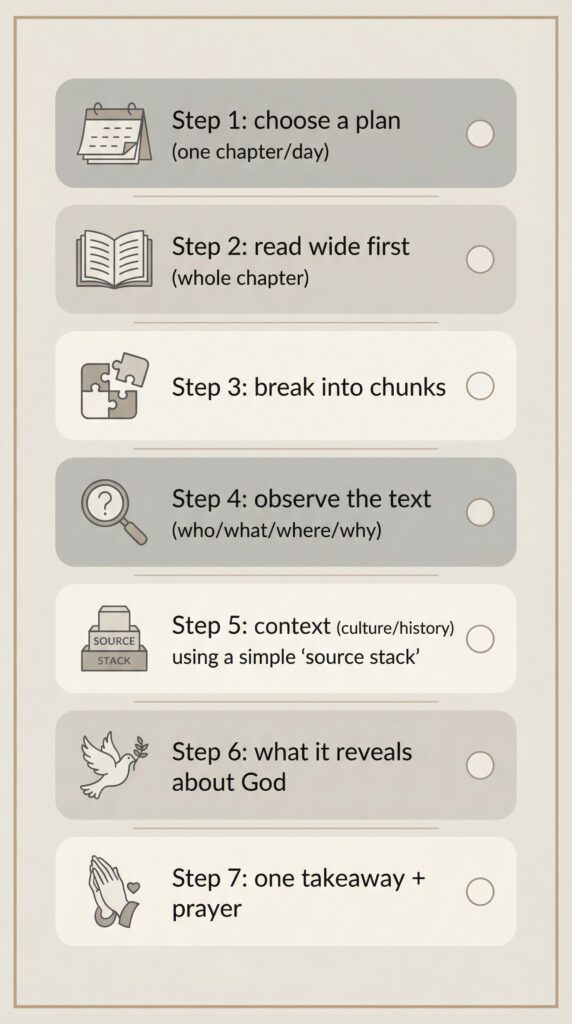
Printable Bible Study Checklist
This simple checklist supports a Bible study method for beginners that builds confidence instead of pressure.
Keep Growing in a Steady Rhythm
If you would like additional guidance and encouragement, you can explore the ROOTED page for a gentle, guided rhythm.
You may also browse the Study and Reflection category for more encouragement, visit the About page to learn the heart behind Meadow and Root, or look through the Shop page for tools that support your quiet time.
You do not have to master Scripture overnight.
You can learn how to study the Bible with confidence.
One chapter.
One day.
One faithful step at a time.
Explore ROOTED if you want a guided rhythm that walks with you.